To find acceleration without time, you can utilize the formula A = ΔV / d, where A stands for acceleration, ΔV for change in velocity, and d for distance. This approach proves handy in scenarios where time measurements are unavailable or irrelevant. By focusing on the change in velocity over a given distance, you can still determine the acceleration of an object with precision. Understanding this method opens up new possibilities for calculating acceleration effectively in various situations. Mastering this technique can enhance your problem-solving skills and broaden your understanding of physics.

Unlocking the Mystery: How to Find Acceleration Without Time
Introduction
Have you ever wondered how objects speed up or slow down without knowing the exact time it takes? Understanding acceleration is like unraveling a fascinating puzzle in the world of physics. In this article, we will delve into the concept of acceleration and learn how to calculate it even without knowing the time involved.
What is Acceleration?
Acceleration is the rate at which an object changes its velocity. Velocity is the speed of an object in a particular direction. So, when an object accelerates, it either speeds up, slows down, or changes direction. This change in velocity can happen due to various factors like gravity, friction, or applied force.
Calculating Acceleration
To calculate acceleration, you usually need to know the change in velocity and the time it takes for that change to occur. The formula for acceleration is:
\[ a = \frac{(v_f – v_i)}{t} \]
Where:
– \( a \) = acceleration
– \( v_f \) = final velocity
– \( v_i \) = initial velocity
– \( t \) = time taken
However, there are situations where you can find acceleration without knowing the exact time. Let’s explore some methods to do that.
Method 1: Using Distance and Initial Velocity
One way to determine acceleration without time is by considering the distance traveled and the initial velocity of the object. This method is especially useful when you have information about the distance covered but not the time taken.
Let’s say a car starts from rest and accelerates to a velocity of 30 m/s over a distance of 100 meters. To find the acceleration, we can use the following formula:
\[ a = \frac{v^2 – u^2}{2s} \]
Where:
– \( a \) = acceleration
– \( v \) = final velocity (30 m/s)
– \( u \) = initial velocity (0 m/s)
– \( s \) = distance covered (100 meters)
By plugging in these values, we can calculate the acceleration of the car during this motion.
Example Calculation:
\[ a = \frac{(30^2 – 0^2)}{2*100} \]
\[ a = \frac{900}{200} \]
\[ a = 4.5 \space m/s^2 \]
This means that the car is accelerating at a rate of 4.5 meters per second squared.
Method 2: Using Force and Mass
Another way to find acceleration without time is by considering the force applied to an object and its mass. This method is based on Newton’s second law of motion, which states that the acceleration of an object is directly proportional to the net force acting on it and inversely proportional to its mass.
The formula to calculate acceleration using force and mass is:
\[ a = \frac{F}{m} \]
Where:
– \( a \) = acceleration
– \( F \) = net force acting on the object
– \( m \) = mass of the object
Suppose a force of 20 Newtons is applied to an object with a mass of 5 kilograms. The acceleration of the object can be determined as follows:
\[ a = \frac{20}{5} \]
\[ a = 4 \space m/s^2 \]
This means that the object is accelerating at a rate of 4 meters per second squared under the influence of the applied force.
Method 3: Using Kinematic Equations
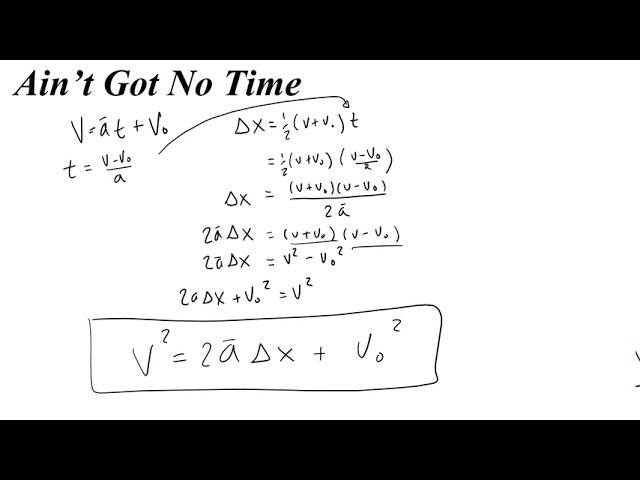
Kinematic equations are a set of formulas that relate the motion of an object to its initial velocity, final velocity, acceleration, and displacement. By manipulating these equations, you can solve for acceleration without needing the time parameter.
One of the commonly used kinematic equations is:
\[ v^2 = u^2 + 2as \]
Where:
– \( v \) = final velocity
– \( u \) = initial velocity
– \( a \) = acceleration
– \( s \) = displacement
If you know the initial velocity, final velocity, and displacement of an object, you can rearrange this equation to find the acceleration:
\[ a = \frac{v^2 – u^2}{2s} \]
This formula allows you to determine acceleration based on the motion parameters of an object even in the absence of time data.
Acceleration is a fundamental concept in physics that describes how objects change their velocity. While time is typically a crucial factor in calculating acceleration, there are alternative methods to find acceleration without knowing the exact time involved. By utilizing distance, initial velocity, force, mass, and kinematic equations, you can decipher the acceleration of objects in various scenarios.
So next time you observe a moving object and wonder about its acceleration, remember that with the right tools and formulas, you can unlock the secrets of motion even without a stopwatch in hand. Physics is full of wonders waiting to be explored, and understanding acceleration without time is just one piece of the puzzle.
Physics Acceleration – With and Without Time 10-3-17
Frequently Asked Questions
How can I calculate acceleration when time is not given?
To find acceleration without time, you can utilize the equation: acceleration = (change in velocity) / (time taken). In this case, if time is not provided, you would need to have information on the initial and final velocities of the object. Simply subtract the initial velocity from the final velocity to get the change in velocity and then divide it by the time taken to calculate acceleration.
What data do I need to determine acceleration without knowing the time?
When trying to find acceleration without time, you must have information on the initial velocity, final velocity, and possibly the distance traveled by the object. With these data points, you can still determine acceleration using the formula: acceleration = (change in velocity) / (time taken).
Can acceleration be calculated if the time is unknown in a problem?
Absolutely! Even if the time is not given in a problem, as long as you have the initial velocity, final velocity, and possibly the distance covered, you can calculate acceleration using the formula: acceleration = (change in velocity) / (time taken), where time taken is not an essential element for the calculation.
Final Thoughts
In summary, finding acceleration without time involves utilizing other known variables like initial velocity and displacement. By rearranging the kinematic equation, a = (vf^2 – vi^2) / (2d), acceleration can be calculated even without time. Understanding this concept is crucial in scenarios where time is unknown but other motion parameters are given. Practicing this method enhances problem-solving skills and deepens comprehension of kinematics. Mastering how to find acceleration without time allows for more flexibility and accuracy in physics calculations.